2025 $165M School Bond
Updated: 12/6/25
Mercer Islanders Defeat the $165,000,000 School District bond
Rejection of this $165M School bond is widely seen as a significant success for fiscal responsibility and community accountability. This decisive “NO” vote sends a clear mandate to the School Board (& to the City) to return with a more focused and prioritized proposition with the following messages:
1. Halting an Excessive and Irresponsible Financial Commitment
The rejection of Proposition 1 successfully averted a substantial financial burden on Mercer Island taxpayers.
-
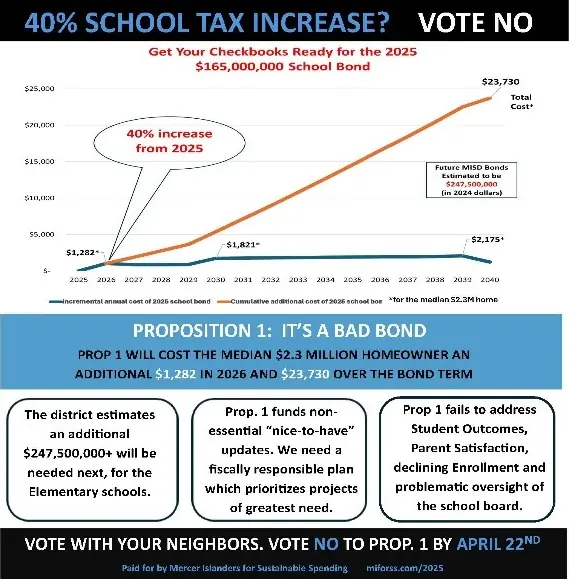
- Cost Avoided: The proposed bond was an initial commitment of $165,000,000. The MISS campaign highlighted the true cost to taxpayers, when accounting for interest charges over the life of the bond, was estimated at $231,000,000.
- Preventing a Massive Tax Increase: Had the measure passed, the median homeowner (assessed at $2.3 million) would have faced an additional $1,282 in the first year (2026), representing a 40% increase over the current local school tax burden. The failure prevents this steep initial hike and saves the median homeowner an estimated $23,730 over the bond’s term.
- Averting Future Debt Stacking: Voters succeeded in temporarily halting what MISS pointed out was an unsustainable cycle of debt. The defeated $165 million bond was projected to be followed by three future school bonds totaling an estimated $248,000,000 for elementary school renovations.
The vote reinforced the community’s demand for responsible stewardship of public funds, particularly as the district’s financial health was a key concern cited as documented in the decline in the General Fund’s reserves from 9.9% in 2019 to 3.6% today, and Moody’s downgrading the district’s bond rating twice (from Aaa to Aa1 in 2022, and further to Aa2 in 2024).
2. Demanding a Focus on Core Educational Priorities
The community successfully utilized the vote to redirect the district’s focus toward improving student outcomes rather than funding non-essential construction projects.
- Rejection of “Nice-to-Have” Projects: The opposition successfully argued that the proposed bond funded a non-prioritized list of projects, many of which were deemed non-critical amenities or items that should be funded through the Capital and Technology (Cap/Tech) Levy. Examples cited as questionable priorities included landscaping, building painting, new lockers, “inclusive” changing rooms, acoustic improvements at MIHS, a second commons at Islander Middle School (IMS), and access improvements at the Administration Building after 35 years.
- A “Wake-up Call” for Academic Rigor: Voters expressed discontent over declining academic quality, despite having supportive families. Evidence presented included:
◦ Enrollment dropped by 14% since AY-2019 (a decline of 521 students since 2019-2020).
◦ General Fund expenses rose by 21% despite the enrollment decline.
◦ One in four students were reported as not meeting grade-level standards in math and science.
◦ Parent satisfaction regarding preparedness for the future fell from 68% to 59%. The defeat was intended to force the Board to focus on improving learning “from within” rather than pursuing “shiny new facilities” that would not inherently improve student outcomes.
3. Upholding a Historical Precedent for Accountable Funding
By rejecting the large, comprehensive package, the voters followed a historically successful pattern for the Mercer Island School District.
- Pattern of Correction: The District has a documented history of presenting large initial bond proposals that were not approved, followed by scaled-back, focused packages that subsequently passed.
◦ A $49.5 million bond proposal failed in 1990, followed by successful smaller bonds in 1993, 1994, and 1996.
◦ A $200 million bond measure failed in 2012, followed two years later by a successful $98.8 million bond proposal in 2014.
- Success of the Mandate: The “NO” vote ensures the District must now adopt a strategy of presenting a “better proposition”, which traditionally results in more “focused and accountable bonds”. This approach prioritizes core capital needs and respects the taxpayers’ desire for a phased, financially responsible plan, possibly prioritizing the renovation of older elementary schools, which many believe are in more urgent need based on a comprehensive long term plan.