

Photo credit: Street View image capture: November 2022, ©2025 Google
Mercer Island’s Robust Finances: A Case for Reallocating Funds to Minimize New Bonds
Strong Financial Position Driven by Tax Capacity
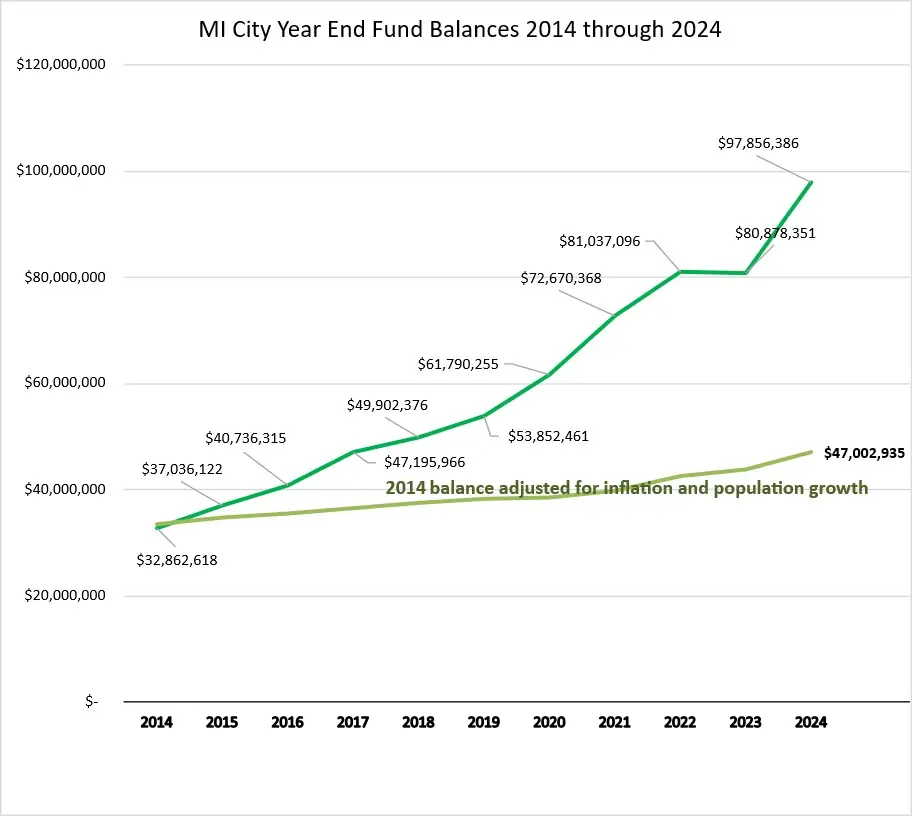
The City of Mercer Island boasts a robust fiscal standing, with a total fund balance that surged 164% over the past decade, reaching nearly $100 million by the end of 2024. This financial strength stems more from the community’s ability to absorb tax increases than from stringent expense control, raising questions about the size of new tax measures like the proposed $103M city bond.
Risks of Maintaining Large Fund Balances
With a near $100 million balance across various funds managed by the Finance Director, concerns arise about potential over-taxation. Large fund balances risk losing their intended purpose, a phenomenon known as money “losing its color” due to its fungibility. The Council’s primary responsibility is financial stewardship. Often funds can be shifted between accounts, potentially leading to expenditures on projects not originally intended by the public, or pre-empted by more important projects like the $103M city bond. Additionally, substantial reserves may create a “burning a hole in the pocket” effect, prompting spending on projects that bypass the rigorous public scrutiny typically applied to levies or bonds.
Breaking Down Available Funds
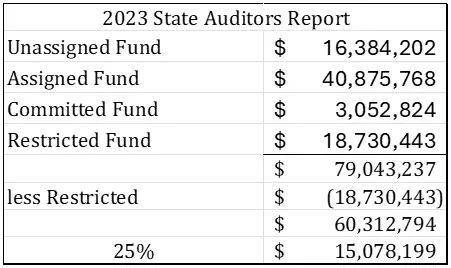
The 2023 Financial Statements Audit Report | MuniDocs | Mercer Island, WA | Municode Library defines the city’s fund categories as: Reserve, Committed, Assigned and Unassigned. These categories offer insight into how much funding could be reallocated to address a proposed city bond without additional taxation.
Unassigned Fund Balance: Flexible Resources
The Unassigned Fund Balance, totaling $16,384,202, represents the least restricted funds, available for immediate use, such as paying down a city bond. These funds are what remain after accounting for restricted, committed, and assigned categories, making them a prime candidate for reallocation. (The City uses the term “Available” instead of “Unassigned.”)
Assigned Fund Balance: Reassessing Temporary Projects
The Assigned Fund Balance, amounting to $40,875,768, is earmarked for temporary projects by council policy. As these allocations are council-driven, they can be reprioritized. A review of these projects could free up funds for the city bond, with an estimated 25% ($15 million) potentially redirectable.
Committed Fund Balance: Long-Term Flexibility
The Committed Fund Balance, at $3,052,824, supports longer-term projects or liabilities but remains subject to council reprioritization. These funds could also be reallocated to address the city bond, offering additional flexibility in financial planning.
Restricted or Reserve Fund Balance: Limited by External Constraints
The Restricted Fund Balance, totaling $18,730,443, is the most constrained, limited by external authorities. While less flexible, it underscores the need to focus on reallocating other fund categories to avoid new tax burdens.
City Financial Reports: Highlighting Available Funds
The City’s Annual Financial Report and Quarterly Financial Reports use the term “Available” interchangeably with “Unassigned,” identifying $36,948,723 in this category. As the least restrictive funds, an estimated 35% ($13 million) could be reprioritized for the city bond, further reducing the need for additional taxation.

Conclusion: Prioritizing Fiscal Responsibility
Mercer Island’s nearly $100 million fund balance reflects a strong financial position that minimizes the size of new bonds or tax increases. By reprioritizing approximately $28 million from Unassigned, Assigned, and Committed Funds, the City Council can address infrastructure needs while maintaining fiscal discipline. Residents deserve transparency and prudent management to ensure funds are used as intended, without adding to the tax burden.